During our planning for final project, we ended up deciding that our game would be a mobile based one. Now while our team is disbanded and will no longer be making this particular game, I’m still going to post about mobile hardware because reasons. (Primarily grades reasons)
In reaching this decision, I decided to research the limitations of the mobile platform, and what older mobiles can support our game.
Phones Yo
Current gen mobiles are fairly high spec, with the Samsung S7 being the most recent Android device, it has a fairly large amount of memory and processing power.

With the S7 having a quad core CPU at about 2.1GHz, and with 4gb ram, it’s a beastly phone, comparable to some older computers in some regards. However, it would be really silly to optimise a game for a phone such as this. So I went back to some older phones and tool a look at a random one. Going back 7 years (3 years after the first Iphone) shows a real difference in RAM and processors for phones.

The processor is half the GHz power of the S7 and a quarter of the RAM, but the biggest difference would be the resolution. Newer phones have up to 1400p resolution (with some 2k), while older ones (from even a 2 or 3 years ago) barely scraped passed 720p.
So, lets now look at the numbers of who owns what phones, and see what area we should be targeting for optimisation and minimum phone requirements.
Looking at a 2015 report from OpenSignal, we can get a real clear breakdown of what devices are being used and how many people are using it.
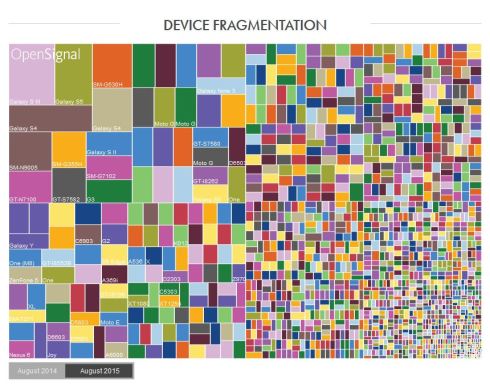
We can see here, the Galaxy S3 and S4 are the largest of all the phone types. However, there are still a fairly large amount of S2 users in there. As we want to accomidate the lowest common denominator here, we’ll take a look at the S2 specs.

Released a year after the “Epic 4G”, its a bit better in terms of specs. Same resolution, but more RAM, more storage, and a slightly more power processor.
This tells me a few things:
- Keeping the default resolution of your game down to is important with such a low default resolution. If we don’t have checks to see the actual size of the screen, then downsampling will become a real problem, eating into CPU resources and causing excess battery drain.
- Keeping asset size down is SUPER important. While onboard storage isn’t too much of a problem with 16 gb of storage (though still a consideration, and other carriers may have lower storages), the RAM is a major problem. Having only 1GB of RAM means that the number of assets you load into memory becomes limited, and assuming that the Android OS eats up at least a quarter of that RAM, alongside any other programs that will be running in the background, we’re looking at 300-400mb of usage for our game MAX.
Conclusion
If we were to proceed with our final project in its current state, I would be using the S2 as a baseline for performance and optimisation due to its still fairly large userbase and popularity.
 Caleb Barton | Games Programmer