For the last four weeks I’ve been working on a board game titled Darkest Depths, a coop(ish) dungeon crawler where you have to defeat the big bad.
About the Game
We were given the brief that we had to make a board game with these constraints:
- Must be a 3 player game
- Has to be linear
- Has to have a playtime of 15-20 minutes
- The stakes or intensity must increase over time
- Has to use a randomiser of Tarot Cards
- Has to have the goal of “Discover the Thing/Follow the Clues”
With these in mind, our group went about devising a board game. The first idea that stuck out was a dungeon crawler, where you follow the clues to the boss to defeat it.
The final design we ended up with was a coop game where players have to work together to defeat encounters.
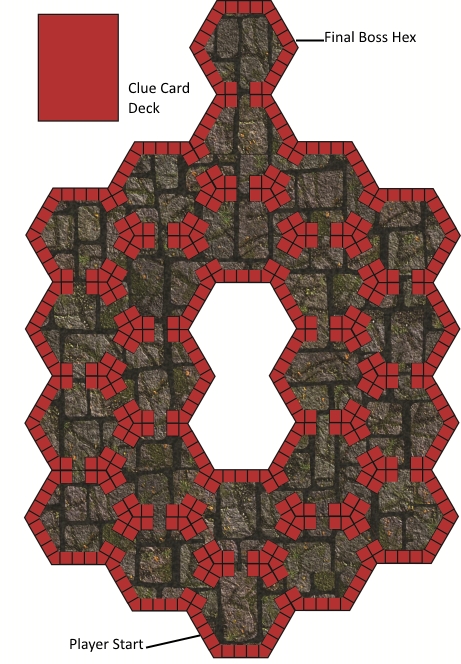
Players would move to adjacent tiles, which has Tarot cards on the hexes representing the encounters. Players would then have to put together their energy (represented as tokens) to defeat the encounter. The catch being we designed the game to be as selfish as possible, while still forcing the players to work together.
Players then gained the tarot cards as items when defeating the encounter, which could be used on later encounters or on the Boss.
The Boss has two stages to the fight, which are two separate health pools that the players have to beat. As the group have been moving throughout the board, Clue cards are being drawn from the clue deck. Beating an encounter means the players uncover something about the boss which will affect the final boss fight. Clues are used as lore for the game in addition to this, and can change things about the boss such as how many minions it has, what kind of attacks it can do, and whether or not the players need to achieve something beforehand.
What went well
The game playtime and player flow worked out well. As players were confined to a single player token, this made movement far easier for everyone. In addition, because there was no “player turns”, but players fighting for control of the party, the play time was considerably shorter than what it could have been.
The complexity of Darkest Depths has its goods and bads. When I use complexity here, I’m referring to many different mechanics all interlocking with each other in certain contexts. The positive to the games complex mechanics is that it allowed for a great deal of re-playability and created interesting inter-party dynamics. An example of this is how player character abilities could be used to benefit the character at the expense of the group, but could cripple the entire groups chance at beating the Boss.
Inter party “coopish” gameplay was something we’ve pushed for for the entirety of the development, and the result is an interesting dynamic between players. Most players have choices in regard to item use, energy bidding, and character abilities that usually results in a trade off of personal gain, or group gain. Trying to balance these things has been interesting for design, as some abilities benefited the group too much, such as our original design for the Cleric archetype which had no selfish aspect to it at all. On the other hand, some mechanics were too selfish focused, which caused games to be lost too often due to how good some abilities were. On the whole, this design worked fairly well, but could use improvement as a dynamic to encourage this style of gameplay more often.
What went not well
While the complexity of the gameplay was a positive for the game, but was also a drawback. The primary barrier for new people playing the game was the sheer amount of information they had to take in all at once before playing the game. However, once this barrier was overcome, then the game flowed really well. Games took 15-25 minutes after reading the rules, and players reached a flow of bidding, using items and choosing where to move.
Some of these mechanics were the result of adding more and more mechanics into the game to address design concerns. For example, we attempted to fix players zero bidding all the time (and thus keeping energy for themselves to beat the game later), by adding curses into the game, which made players lose tokens on certain hexes. While this worked in making where to move interesting, this was yet another rule players had to remember when they had their turn. In the future, we should consider changing how the mechanics of the game work before adding more mechanics to fix a problem.
Clues as a mechanic were interesting, but I believe in hindsight there was probably a more interesting way of delivering information about the Boss.
Playtesting was (I believe) a minor setback for the game, as we should have been playtesting earlier into the design process. We only did our first playtest two weeks into the project, and although we tested more frequently after that, if we had started the process earlier we may have had a further fleshed out game.
Conclusion
Although Darkest Depths is probably more complicated and fluffed than it needs to be, I believe that this board game has quite a bit of potential, and I plan on elaborating on the design of this game after the end date of the project.
 Caleb Barton | Games Programmer